Showing posts with label myth. Show all posts

Tuesday, July 20, 2021

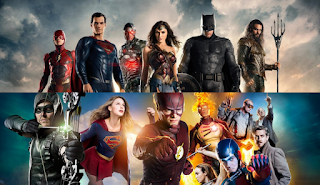
 WHY SUPERHEROES?

su·per·he·ro
/ˈso͞opərˌhirō/

noun

  • 1.a benevolent fictional character with superhuman powers, such as Superman.


    A fun idea. but that's all, right? No real use in life.

    Superman can't save you in an airplane crash. Batman can't stop crime. Wonder Woman can't end war. 

Iron Man  can't invent new technology. 

    We-ell ... they can't, not directly  We want those things, we have to do them ourselves. What superheroes can do is inspire us. 

    It doesn't matter how hard you try, you'll never run as fast as The Flash. Work out as much as you will, you'll never be as strong as Superman. You'll never fly or even leap as high as Spider-man. 

BUT.

    Try and run, work out, train well ~ try to leap and of course you'll never do those things ... but you will try harder, run a little faster, be a little stronger, leap a little higher and farther. 

    Study as hard and deeply as you want, you'll never be as smart as Tony Stark or Banner You won't invent armored suits, time travel or quantum displacement. But you'll be a little smarter, know a little more ~ and maybe make a small breakthrough that will lead somebody to another breakthrough and another ... You might even discover a minor moon or asteroid or a new star or evidence that leads to a rogue planet. 

    Study criminal science, forensics, chemistry, psychology ~ everything that Sherlock Holmes or Batman know, you won't be able to deduce answers, solve mysteries or apply logic like those fictional detectives But you'll know a little more, 

    Work for peace with love and truth and reason. You won't end war or hate or bigotry. But your attitude may help you resolve a small dispute. Your reason may impress someone else. You may create a small ripple that may spread. It may have results down the line that you won't ever realize.

    Take all the daring saves and incredible escapes. Nobody is going to fall out of an exploding plane, save people and battle bad guys on the way down, survive certain death from colliding debris numberless times.  But you might fight a little harder, persevere a little more. hold on a little longer, take a desperate chance. And such things may make a difference.

    Even the ones who do impossible things: that no amount of training or study or will can achieve: Harry Potter, Doctor Strange, Green Lantern ... Magic or superscience that doesn't exist... can still inspire us to try harder, persevere longer, believe in ourselves. 


Never feel guilty for loving superheroes, on film or in comics. They are as useful as any myth.

Tuesday, October 28, 2008

Born on Krypton


Remember what I was saying about popular fiction becoming a new mythology? This guy realizes that our mythic heroes resonate with more people than even the country's major religion. A masterful way of connecting with everyday people that his opponents only wish they could acheive with their "Joe Six Pack" talk.

Monday, February 25, 2008

Misusing Myth, I


“Stereotypes are devices for saving a biased person the trouble of learning” ~ Anonymous

" ... the Cold War was not some naturally occurring phenomenon but was created by U.S. policymakers in large part for the purpose of keeping a lid on social change ... " ~ Robert Jensen


"The twelve labors of Hercules were trifling in comparison with those which (political pundits and tabloid journalists) have undertaken; for they were only twelve, and had an end; but I could never see that these men slew or captured any monster or finished any labor." ~ Henry David Thoreau


The image above is what Japanese people looked like during World war II - at least if you read American comic books. Comic books were one of the worst offenders for racial stereotyping back then. Japanese had bright yellow-orange skin, long fangs and claws... and were usually being killed by handsome American heroes like Airboy (pilot of Birdie, the only plane that flapped her wings). Chinese looked similar, only without the fangs and with huge buck teeth. It wasn't just pictures: one story had Japanese agents recruiting circus freaks to their cause because "the Japs are a race of freaks themselves." But it's one thing to use demons to symbolize the evils of Nazism or Japanese imperialism and quite another to depict a people as demons. Heroes like Captain America, The Patriot, USA, Captain Flag, V( for Victory)-Man and their like were wonderful morale boosters for Americans, but drawing "Japs" as monsters didn't promote peaceful understanding... any more than cartoons of "camel jockeys" help it now.

Like anything empowering, myths and stories can be misused, even abused. One of the worst examples is when stories go from archetypes to stereotypes. The lazy, cowardly Black, the inscutable Oriental, the greedy Jew, the helpless heroine and the effeminate gay man pop up in a lot of War-era fiction and beyond in a vicious circle: the stereotypes appear because people believed them and the stories reinforce the belief. Modern versions that sound more positive, like the streetwise Black, the kung-fu Asian, the sensitive gay and the man-hating feminist are just as bad because they're stereotypes. They feed the delusion that all members of a social group are the same, not individuals, and this can lead to real evils from profiling to genocide.

Stereotyping is only one way myth can be misused. I've talked about how believing in myths literally leads to the kind of hatred preached by fundamentalist religions from evangelical Christians to Islamic Jihadists.

People can use myths wrongheadedly to promote their own causes. Detractors of Barack Obama who call him "two-faced" like "the Roman god Janus" or warn of his Islamic leanings because his name means the winged horse (El Buraq) that Mohammed rode to Heaven have unknowingly given him pretty solid symbolic endorsements. Janus, as the Presidential Geek Survey at pinkraygun.com points out, represented not forgetting the past while looking ahead to the future. And El Buraq was a winged steed who brought people to paradise. It even represents a healing of religious wounds: on his arrival Mohammed was blessed by Abraham, Isaac, Joseph, Moses and Jesus, and welcomed as their equal. (1)

Bush supporters who tried to paint him as Frodo or the Lone Ranger miss the point so far that they're laughable. The Lone Ranger never answered an Indian raid by wiping out their tribe (or, as with Bush, the wrong tribe, because they had silver mines he wanted). IMHO Bush is more like Sauron than Frodo. There's a fascinating take on THE LORD OF THE RINGS and American politics at http://www.windweaver.com/politics/lordrings.htm making the point that Frodo's real battle was with his own dark side tempted by the Ring than with Mordor. Which is what myths are really all about anyway.

There are also people who will create a mythology and perpetrate it. These include groups from politicians to UFO believers to tabloid journalists to so-called prophets. I used to teach a Wichita Free University course in UFOlogy, and many of these diverse groups use a lot of techniques in common. UFOlogists will be discussed here in more detail later, because their mythology borrows from stories in popular fiction. What were Iraq's weapons of mass destruction but a created myth? Tabloids live by feeding us myths of the rich and famous

I'll get more into "creative myth," UFOs and such in Misusing Myth II.


(1) And the latest in their line of prophets: which reminds my geek side of “Into each generation a slayer is born ... a Chosen One. One born with the strength and skill to hunt the vampires, to stop the spread of evil.”

Monday, December 3, 2007

The Summerlands and Beyond

"Behind the walls of the Pélori the Valar estab- lished their domain in that region which is called Valinor; and there were their houses, their gardens, and their towers. In that guarded land the Valar gathered great store of light and all the fairest things that were saved from the ruin; and many others yet fairer they made anew, and Valinor became more beautiful even than Middle-Earth in the Spring of Arda and it was blessed, for the Deathless dwelt there, and there naught faded nor withered, neither was there any stain upon flower or leaf in that land, nor any corruption or sickness in anything that lived; for the very stones and waters were hallowed." ~JRR Tolkien, THE SILMARILLION

"May it be a light for you in dark places, when all other lights go out." ~Galadriel

"I look forward to the day when your people join us beyond the rim. We will wait for you. ” ~ Lorien, BABYLON 5

"There is no conclusive evidence of life after death. But there is no evidence of any sort against it. Soon enough you will know. So why fret about it?" ~ Robert A Heinlein, THE NOTEBOOKS OF LAZARUS LONG

"Since life and death are each other's companions, why worry about them? All beings are one." (Chuang-Tzu)

A friend of mine passed last week. He was a young man, bright and intelligent, working for his Masters in Literature. We called him the God of Computers, because he could tell us how to solve any computer problem. During his recent hospital stay, he fixed the nurses' computers in exchange for Kit Kat bars. We used to gather to watch STARGATE on Friday nights. Since I lost my car, I wasn't able to visit him as much as I'd like to. I will miss him.

The Egyptians were about the first to have a complex afterlife system. Reaching the paradisal Fields of Aaru was quite a task: you had to be mummified, weighed against a feather of the goddess Ma'at, and pass a long journey to gates guarded by demons. The Norse had Valhalla, where warriors fight and hack each other to bits eternally, restored in time for the evening feasts. The Aztec paradise was also for warriors, and people who died of old age or disease went to dark Mictlan or the brighter Tlalocan. To the Greeks the Underworld was a land where souls lived as bodiless shades. The Celts had the Summerlands, a place of eternal peace and beauty where everyone except really bad souls lived and only certain great heroes ever returned to the Earth. Judaism named the underworld Sheol, a part of which was Gehenna, a place of fire that purified souls and destroyed evil.

Jesus talked in parables using the Jewish myth-system as a metaphor for spiritual anguish and cleansing, but he was taken literally, and Hell became an eternal torment - a horrible thing to ascribe to a loving God.

In Eastern religions there are several hells, also seen as places of atonement for bad karma. Karma is also worked off in reincarnations. Eastern beliefs, though, are more concerned with enlightment than places of rest or punishment. Samsara, the cycle of life, called in Vedanta "the state of becoming," is a path of learning that leads to moksha, "freedom from limitations."

Modern pagan systems like Wicca have melded the Celtic afterlife with reincarnation, viewing the Summerlands as a place of rest and reflection between lifetimes.

In THE LORD OF THE RINGS, Valinor is very like the Summerlands. It is reserved for the immortal Elves and can only be reached from the Grey Havens by the Straight Road. Frodo and his fellows are given special dispensation to live there after their adventures.

Most modern popular myths use traditional versions of the afterlife, but there are some new ideas.

Edgar Rice Burroughs, before Tarzan, wrote UNDER THE MOONS OF MARS. His hero John Carter basically dies on Earth and is transported bodily to Mars. Barsoom (the Martian name for their planet) was unlike anything NASA found, with dry sea bottoms under two moons, swordsmen, four-armed green warriors, airships and princesses. ERB meant it as fantasy, and he never said directly that Carter had died, but it did bring up the idea of being reborn on other worlds.

Michael Moorcock took this a quantum leap forward. His Eternal Champion exists in many dimensions of the "Multiverse." Elric of Melniboné, Dorian Hawkmoon, Corum Jhaelin Irsei, Jerry Cornelius, Erekosé and many more are all facets of one being. In such a system the death of one incarnation would not mean the end of the person.

My Christian Science chaplain once described death by saying that, while you seem dead to the rest of the world, to you nothing has changed; you just go on living. That suggests not only the Taoist belief that life and death are merely two aspects of one being, Yin and Yang, but also concepts from quantum physics like Schroedinger's Cat, where the cat is both dead and alive until observed. More on that in later blogs.

All I know is that if there is a Summerlands or a Valhalla, their computers are working now!

Monday, November 19, 2007

Quotes

The scene to the left includes a corny line from a 1951 Buck Rogers Sunday comics page, but it's one that has stuck with me all through life. "A guy's never done for till he quits breathing." I like it's simplicity better than "Never give up, never surrender" because it simply states a fact: as long as you're alive there are always choices. It seems to pop into my head and get me through tough times.

Here is another deceptively simple one: the Green Lantern's oath from the original 1940s comic books, "I shall shed my light over dark evil, for the dark things cannot stand the light ... "

Light dispells darkness as knowledge dispells ignorance, Life dispells death.

A Maori proverb says, "Turn your face to the sun and the shadows fall behind you."

"As far as we can discern, the sole purpose of human existence is to kindle a light in the darkness of mere being." ~Carl Jung

Here's a mix of quotes by people real and fictional about mythology and stories, spirit and the universe:

"Legends are the spice of the universe ... because they have a way of sometimes coming true." ~Captain Jean-Luc Picard, STAR TREK THE NEXT GENERATION

"Imagination is more important than knowledge." ~Albert Einstein

"'Mythology' is what we call someone else's religion." ~Joseph Campbell

"I have recently been examining all the known superstitions of the world, and do not find in our particular superstition one redeeming feature. They are all alike, founded upon fables and mythologies." ~Thomas Jefferson

"When I talk about belief, why do you always assume I’m talking about God?" ~ Shepherd Book, SERENITY

"God goes by many names, perhaps some alien sounding, different faces, and history, but all describing the same Creator." ~Brother Theo, BABYLON 5

"Many paths lead from
The foot of the mountain,
But at the peak
We all gaze at the
Single bright moon." ~Ikkyu

"Do you think He's really out there!?" -- Doctor McCoy
"He's not out there Bones, He's in here." -- Captain Kirk ~STAR TREK V

"The molecules of your body are the same molecules that make up this station and the nebula outside, that burn inside the stars themselves. We are starstuff, we are the universe made manifest, trying to figure itself out." ~Delenn, BABYLON 5

"The whole room, four walls, the floor, and the ceiling, everything, albeit distorted, is compressed into that one small circle.… No matter how you turn or twist yourself, you can’t get out of that central point [between your eyes]. You are immovably the focus of your world." ~MC Escher

"Do you know like we were saying, about the earth revolving? It's like when you're a kid, the first time they tell you that the world's turning, and you just can't quite believe it cuz everything looks like it's standing still. I can feel it. The turn of the earth. The ground beneath our feet is spinning at a thousand miles an hour, and the entire planet is hurtling around the sun at 67000 miles an hour. And I can feel it. We're falling through space, you and me, clinging to the skin of this tiny little world, and if we let go... That's who I am. " ~The Doctor, DOCTOR WHO

"What appears to be coming at you may be coming from you." ~Meatball
Fulton

"If one advances confidently in the direction of his dreams, and endeavors to live the life which he has imagined, he will meet with a success unexpected in common hours." ~Henry David Thoreau

"If you confront the universe with good intentions in your heart, it will reflect that and reward your intent. Usually. It just doesn't always do it in the way you expect." ~G'Kar, BABYLON 5

I'll be doing occasional quote posts, so if anybody has any good ones to share, please send 'em along!

Tuesday, October 30, 2007

The Tree of Life and Death


I once said to an Air Force Christian Scientist chaplain that at that moment I felt so at peace that I didn't care if there was such a thing as eternal life or not. She replied, "There, you have found eternal life!"


“... one of what we all are: Less than a drop in the great blue motion of sunlit sea. But it seems that some of the drops sparkle. ... They do sparkle!” ~ King Arthur, Camelot by Lerner and Lowe


Two of the most potent icons that appear in different myths are intertwined. The image of the World Tree exists in most cultures --including pop culture-- and the story of the hero who dies and returns is always linked to it. Perhaps a tree's roots deep in the ground with branches reaching to the sky symbolizes our connection to the All. Its cycle of decay in Fall and Winter and rebirth in Spring and Summer represents the cycle death and resurrection. Religions tend to celebrate their heroes' or dieties' rebirth around the coming of Spring, when the world itself seems to be coming back to life.

Death and resurrection are a key theme in mythology. We want to know that we are eternal, or, at least, a part ofsomething that is. Most heroes of most myth-cycles are tasked to reaffirm this by dying and coming back. At the least, they experience a life change so profound that it is like being reborn. The Norse god Odin was nailed to the Tree Yggdrasil to gain knowledge, including the ability to enter the Land of the Dead and return. A gigantic tamarisk tree grew from the spot where the Egyptian god Osiris died; he was later resurrected by Isis after five days in the Underworld. Buddha found enlightenment sittiing under the bodhi tree. Christ died on a symbolic tree, the wooden cross, and was resurrected three days later. Arthur's mentor Merlin was associated symbolically with an oak tree. In modern myths Luke Skywalker faced his fears in the tree on Dagobah to become a Jedi Knight. It might even be said that Buffy's wooden stakes and Harry Potter's wands are shards of the great Tree. In fact, it is significant that Harry met his own death and returned amid the trees in the Forbidden Forest, and Buffy's death came on a tower that reached up like a tree.

Even without the symbol of the tree, most major popular culture heroes have an element of death and rebirth in their stories, keeping them firmly in the classic mythic tradition. Superman was sent out like a seed pod from a dying planet. The Lone Ranger was the last survivor of a band of Texas Rangers left for dead by the Cavendish gang; he even left a grave marker. Buck Rogers was overcome by an underground gas that left him in a deathlike state until he awoke in the 25th century. Denny Colt was doused with a chemical that left him in suspended animation; he was buried in a vault in Wildwood Cemetary that later became his hideout and base when he awoke and named himself The Spirit(1). Most of today's super heroes survive origins that would normally be lethal: struck by lightning, hit by a meteor, exposed to radioactive or toxic waste. It seems a hero just isn't a hero until he has met Death and lived to tell the tale.

Speaking of cycles, The Celtic celebration of the end of the harvest season and the coming of the season of death is tomorrow night. It was known in Gaelic as Oidhche Shamhna, or in modern terms Samhain, All Hallows Eve or Hallowe'en. It was the end of the year. Some traditions hold that on this night the veil between the worlds of the living and the dead is thinnest. The ancients celebrated the aspect of Death because they knew that it is only part of an never-ending cycle, that while the old world died the darkness was germinating the seeds of the new. When you can see that, you've found eternal life.


(1) If you don't know the classic comic book hero, don't worry: the movie is out next year!)

Monday, October 22, 2007

Truer Than Truth


"Is there anything truer than truth? Yes, Legend." - Kazantzakis

"These things never happened, but are always" - Sallust

"We all know that art is not truth. Art is a lie that makes us realize the truth." - Picasso


As I promised last time, my personal thoughts on religion. Posting these to help explain why I'm comparing certain religious teachings to myth.

There is only One True Religion. It goes under different names depending on whom you're talking to. Christianity, Buddhism, Islam, Judaism, Tao, Wicca, atheism and a million more. Why people can't recognize this I don't know. Sometimes it seems they just don't want to. All the faiths have one core truth:

"There is vast Mystery in the universe and we are all part of it, so we should be kind to each other."

That's it. Everything else, everything else, is details.

Religion and myth not only tell us the same truth, they are identical. Their stories tell us that, despite our "Infinite Diversity in Infinite Combinations" (1) we all dream in common. That we are worthy, that dragons can be slain, evil powers humbled, death outlived.

We can use the power in myth as long as we remember to name it myth. It's when myth gets confused with literal truth that we get in trouble. People can start believing that only their myth is true, that they are special or Chosen, and they can feel free to put down other people. But worst of all, literalness brings in dogma and ceremony and robs them of the true meaning of the stories. Christianity is just a new myth that perpetuates elements of older stories. There were virgin births, crucificions and resurrections for thousands of years before Christ. Nearly every religion teaches the same Golden Rule. The new religion incorporated those old, powerful images the same way it took over the ancient pagan holidays.

Personally, I prefer Zen with its lack of gods, or Wicca, whose followers admit that the gods and powers they invoke may be just tools to focus thought.

I'm not saying all this to antagonize anybody. Just to set down my take on religion and to explain why it's necessary to consider religious myths along with pagan and Eastern and even pop culture myths. Religion is not "just another myth." No matter what you call them, myths hold powerful truths. Just look for the truth beyond the dogma. As Bruce Lee said in ENTER THE DRAGON, "It's like a finger pointing away to the moon. Don't concentrate on the finger, or you will miss all that heavenly glory."

I'll discuss two of the most profound myths next week, in the Tree of Life, and Death.


(1) IDIC: The Vulcan philosophy of STAR TREK by Gene Roddenberry

Monday, October 15, 2007

The Hero With a Thousand Faces

"Stories are signposts to help the world choose between the darkness and the light." ~Arago


Angel, from the Buffy the Vampire Slayer spinoff series, said it this way:

"Nothing in the world is the way it ought to be. It's harsh, and cruel, but that's why there's us. Champions. It doesn't matter where we come from, or what we've done, or suffered, or even if we make a difference. We live as though the world were as it should be. To show it what it can be."

I talked last post about how the heroes and archetypes of myth recur wearing (as Joseph Campbell says) new masks in all times and cultures. They live the same stories over and over again because the stories hold truths we need to hear.

Here's one about (Campbell again) The Hero With a Thousand Faces:

Once there was a young person named Arthur/Moses/Frodo/Clark Kent/Luke Skywalker/Buffy Somers/Harry Potter who was raised as a commoner, not suspecting his noble heritage. She met a wise old man named Merlin/Gandalf/Obi-Wan Kenobi/Giles/Dumbledore who revealed her true destiny. Granted a weapon of great power called Excalibur/the Staff of God/the One Ring/super powers/a lightsaber/a wooden stake/a phoenix-and-holly wand, he went forth to fight the forces of evil.

The clearest truth in the story is that no matter what our situation we are all greater and nobler than we think. We're worthy, we have a purpose, as the Desiderata says we "have a right to be here."

Young heroes, wise wizards, objects of power, monsters and villains are archetypes that surface in most stories (or is there only one story?) The hero doesn't have to be fantastic. He can be a private detective, his magic kingdom the mean streets of Los Angeles and the dragon may be a corrupt corporation. The swords, rings and wands are icons, symbols of power.

There are more vital truths hidden in myths and fairy tales and popular culture, and many more examples of their recurring patterns. But in order to fully appreciate them we have to include some myths that a lot of people take seriously. Before I get there I'm going to have to digress next post and talk about myth and religion.

Monday, October 8, 2007

Welcome


"Stories are signposts to help the world choose between the darkness and the light." ~Arago


This blog is about spirituality, alternative religions and quantum physics, heroism, but mostly about mythology and folklore and (geeky) pop culture and how they relate.


Arago was a character on a short lived TV series called The Secret Adventures of Jules Verne http://en.wikipedia.org/wiki/The_Secret_Adventures_of_Jules_Verne . He may have been based on Francois Arago http://en.wikipedia.org/wiki/Fran%C3%A7ois_Arago . Arago popularized astronomy, physics and technology in many of his treatises, and championed humanitarian causes such as abolishing flogging in the Navy and slavery in the French colonies. His role in the series was to tell the young Jules Verne that his science fictional writings were important in mankind's dealings with the new technologies that were developing in the late 19th Century ... steam power, airships, world travel. Verne in real life popularized technology by giving it the aura of adventure and wonder and more importantly by giving it a human face. His books were fanciful but wildly popular and, as Einstein said, "Imagination is more important than knowledge."


Joseph Campbell http://en.wikipedia.org/wiki/Joseph_Campbell said that stories, in the form of myths, are powerful, even vital means of connecting us to the "Unknowable," the mystery that is as much in ourselves as in the Universe.

Today we don't have myths that we recognize as such. The main source of myth, religion, takes itself seriously, mistaking stories for literal fact. The myths we all share are found elsewhere, in popular culture whose icons and archetypes come from our own subconscious. They are updates of the old symbols ... Merlin is Dr Zarkov and Obi-Wan Kenobi and Giles and Dumbledore ... They are our minds' and the Universe's way of telling us eternal truths.

I'll be talking about the connections between myth and mind and mystery here, as well as just rambling or ranting. If any of this interests you, you're welcome to come along and join in.