It hardly seems like it was 2014 since I last published!
I am going to combine my political blog LIES AND DAMNED LIES with STORIESARESIGNPOSTS somewhat, at least as long as Donald Trump and Russia threaten our democracy ... and by "our" I mean the world's.
It looks as if the Trump empire is crumbling already though. The so-called "Witch Hunt" is indicting and imprisoning Trump's mob one by one. Trump continues to try and distract with Space Forces, Deep States, rallies and now, bringing up Hillary Clinton's emails - again.
One of the most famous science fiction series is Isaac Asimov's FOUNDATION. a group called the Psycohistorians sets up the Foundation to bring order to the galaxy. They believe that trends in large societies can be predicted mathematically. Everything runs according to plan ... until The Mule is born. Psychohistory cannot predict the actions of an individual, and The Mule is a mutant with powerful psychic abilities. He can reach into the minds of others and "adjust" their emotions, individually or en masse, and win them to his cause - which is conquest.
I see Donald Trump as The Mule. Not that he has any psychic powers, but he does seem able to seize the minds of his followers enough to get them to vote against their own best interests, even to make the religious believe that this racist, lying, womanizing, foul mouthed, cheating you-know-what has been "raised up by God to save America". If democracy had any long term plan, Trump is disrupting it just as The Mule disrupted the Foundation.
It's almost mythic. Look at the names of the characters.
Trump: British slang for fart.
Vladimir: ruler of the world (besides, it sounds like Voldemort)
Mitch (McConnell): urban slang for man-bitch
Robert (Mueller): famed, bright; shining; Mueller means miller (sifting the facts like a miller sifts grain?)
Peter (Strzok): solid as a rock
Barack (Obama): means lightning, but there's more to it. Barack or Baraq was the name of Mohammed's winged horse, who carried the prophet up to Heaven where he met Abraham, Moses, Jesus and other religious figures. A great metaphor for relations between religions.
At any rate, it looks like the long nightmare is drawing to a close. But Republicans and Russians are full of dirty tricks. To purge the voter rolls they have used everything from disenrolling voters for made up reasons to pretending that Russian hacking isn't happening.
Dr McCoy's advice is solid.
Call your local party and make sure you are registered. Get an early ballot or go out to vote on November 6.
As for me, I'm getting my Munchkins ready to sing.
STORIESARESIGNPOSTS hasn't been a particularly political blog. We'll be back next time with a take on one of biggest myths of the 20th and 21st centuries: UFOlogy.
Sunday, August 26, 2018
Monday, June 16, 2014
SAY HELLO TO KAMALA KHAN
I don't like zombie movies. It's not the creepiness or the guts and gore. As I stated in my post on The Hunger Games (http://storiesaresignposts.blogspot.com/2012/12/what-makes-heroine.html), they reinforce and encourage the us-against-them mentality. There's no dealing with zombies (and a lot of video game enemies), no negotiation, no common ground. It makes it easier for the edgers who hold the power in society to get otherwise peaceable people to kill their enemies if they can paint the enemies as less than human. Once you realize that "they" are people like you, it can be harder to kill a fellow human being.
That's why books like the ones I'm reviewing today are so important. Marjane Satrapi's autobiographical graphic novel PERSEOPLIS (also an animated film) show the recent history of Iran and its political issues through the eyes of Marjane as a young girl. She shows how she felt when, overnight, the boys and the girls in her school were segregated into seperate classes and head scarves were made mandatory for the girls. She later experiences the horrors of death, destruction and injustice personally, all the while maintaining her love for freedom and western culture (denim jackets, Iron Maiden and Michael Jackson).
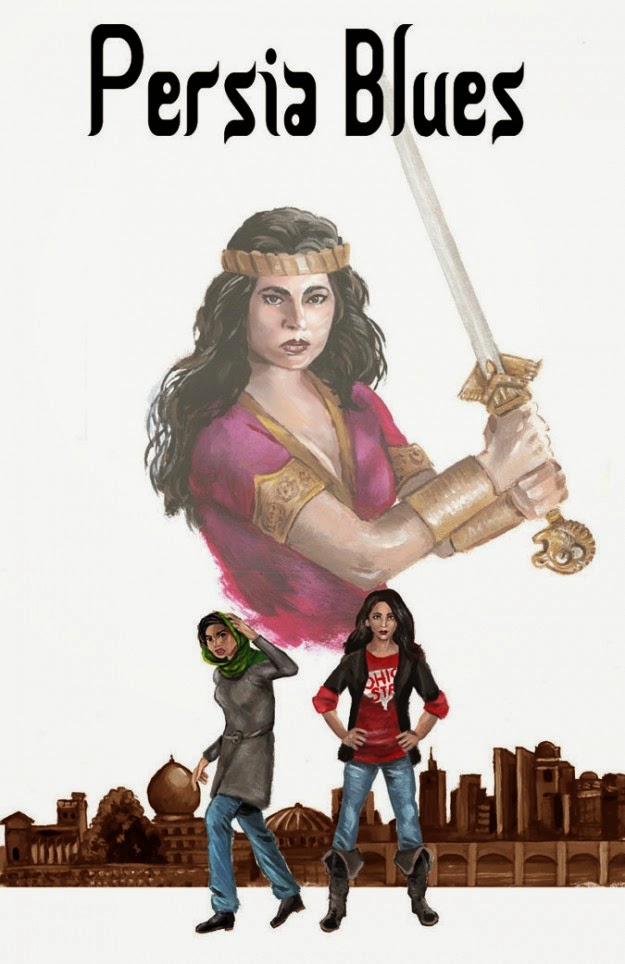
PERSIA BLUES by Dara Naraghi and Brent Bowman is a young adult graphic novel with a similar theme of daily life in Iran, interspersed with the adventures of the heroine's alter ego, a sort of female Conan in ancient Persia.
I've mentioned THE 99 in previous posts (http://storiesaresignposts.blogspot.com/2007/12/in-city-of-all-faiths.html). This wonderful series of comics involves super-powered people from all over the world, but Dr Naif Al-Mutawa created their powers based on the 99 attributes of Allah. The series has them working together for good, despite their differences. Unfortunately THE 99 is no longer published as paper comic books, but they are available as online comics (http://www.the99.org/)
Marvel's new title MS MARVEL may be the most important of this kind of storytelling. Marvel is a major force in comics, movies and TV. It gets more attention. The new Ms Marvel is Kamala Khan, a Pakistani muslim girl living with her family in Jersey City. Her origin is tied to Marvel's Inhumans, Avengers and Captain Marvel titles, so she's hard to ignore if you're a Marvel universe fan. And it's a fun read. Her parents are strictly religious, but Kamala is into normal teenage girl pursuits: parties, texting, being popular, and she's a huge Avengers fan. When she gains shapeshifting powers from the Inhumans' Terrigen Mist, she makes herself a super hero, but it's not the powers or the heroics that are important here. Like the other books, it reveals that, muslim or no, her wants and dreams are no different from anybody else's. Getting readers, especially young readers, to see this is what we need to save the world.
"I believe in my neighbors.
I know their faults and I know that their virtues far outweigh their faults." - Robert A Heinlein,
Labels:
marvel comics,
Ms Marvel,
muslim,
perseopolis,
persia blues,
the 99
Monday, September 9, 2013
MORALITY
I recently attended a discussion on Biblical
morality. When the Bible tacitly
approves of such things as slavery, genocide and rape, they explained that such
things were common in the days when the Bible was written because of the
scarceness of land, water, and livestock, etc.
When I’m arguing with people who say that without a god
(and his punishment/reward system) atheists cannot possibly have any morals, I
usually respond in two ways. One, that a carrot-and-stick is no basis for
morality; if their god took away the threat of Hell, how morally would they
behave? Second, that their god condoned a lot of things that we view as immoral
today; thus if their unchanging god changed his mind again, and decided that such things were okay, would they blindly
obey him?
Thing is, that second argument may be closer to the truth
in real world terms. Global warming may create a lack of land, water and food.
I’m not confident that we wouldn’t change our
minds and decide that the old evils were good after all.
Look how easily we shed our own morals on things like unjustified
invasions, torture, legal rights and privacy after 9/11. It was okay – because we
were the good guys fighting the good fight against, not fellow humans, but bad guys.
The old comics and pulp science fiction I read were pretty naïve.
If anything as disastrous as climate change threatened the world, a coalition
of the greatest minds on Earth would have convened to deal with it.
Everybody would have survived.
In the so-called real world, the only plan anyone has for
dealing with disaster is the Pentagon’s papers on “resource wars.”
Climate change is a real threat in more ways than one. We
might lose our comfortable style of living, our superpower status and our easy
access to oil, habitable land and even water. All the population of the Earth
is in the same boat. And all we’re doing is plotting ways to take away what we
need from other people!
I fear worse than resource losses. We could lose our souls.
The Klingons had it right. “Only a fool fights in a burning
house.”
Monday, December 17, 2012
WHAT MAKES A HEROINE
I was disappointed with reaction from some of the comics and sf fans' base to the film of THE HUNGER GAMES. I couldn't believe that they wanted to know why Katniss didn't just use her forestry and bow skills to kill everybody else and win. That she didn't was the whole point of the story. Just killing and winning - which would have meant taking out Rue and Peeta herself - would have been giving the Capitol what they wanted, a new champion and the continuation of the Games. She wouldn't have been a heroine at all, and I don't think the books would have sold as phenomenally well as they did. She made the powers that be do things her way, and that's why she is a heroine. A hero/ine doesn't just go along for the ride, she shakes up the status quo.
There is a sad trend in popular sf and fantasy to portray violence as the only means of resolving conflicts. You can see it reflected in shooter video games and action and zombie movies to name a few. The enemy is faceless and nonhuman so it's ok to kill them. That's the only way to survive. Peace is never an option. You can't negotiate with the Flood or the Heartless or the Darkspawn or the undead. Even the new STAR TREK movies are about blowing up supervillains; the tv series strove to resolve confrontations peacefully, but that doesn't make good action movies. Neil Degrasse Tyson said, "If you carry around a hammer, all problems begin to look like nails."
Please note that I am not saying that violent video games or movies cause violence or hate - people like Osama bin Laden, Adolph Hitler and Fred Phelps did not grow up playing video games. But it reflects and reinforces the already existing feeling that our perceived enemies are not like us, fags or ragheads or gooks or Jews or infidels or whatever hate words are being used. It's a mental state that's been with us since prehistory but it's one that we can survive without. A while ago the government had a leaked plan for how to survive climate change or the loss of natural fuels, land or water. It was all about Resource Wars, fighting over them. Nothing about any sharing or cooperation between nations so that everybody lives. Even the Klingons had a proverb: "Only a fool fights in a burning house." A lot of sf/fantasy from Trek to comic books used to be above that kind of thinking.
And now we have drone weapons that you can kill with impersonally without ever seeing your victims' faces. Remember how outraged you feel when some sick shooter in Colorado or Connecticut kills innocent men, women and kids? Happens all the time in places like Pakistan, and we can't understand why they hate us.
Today's heroes are a violent lot. Superheroes used to have a personal code against killing. They won as often as not by outsmarting the bad guys - not just by being meaner and harder. In the scene above Green Lantern proved Sinestro (the red guy for non comics fans) wrong by sealing him in a big green bubble (hey, it's a comic book; point was, GL didn't kill him. It's no more unbelievable than Batman dodging assault weapons fire or Wolverine carving up a hundred ninjas.)
The idea that enemies are not like us so we have to kill them is something the human race needs to put behind us. The only ones who profit are the political hawks and religious fanatics who use it to send people to fight their wars and the rich who only want to carve up what's left. Why, as some would have Katniss do, give them what they want?
There is a sad trend in popular sf and fantasy to portray violence as the only means of resolving conflicts. You can see it reflected in shooter video games and action and zombie movies to name a few. The enemy is faceless and nonhuman so it's ok to kill them. That's the only way to survive. Peace is never an option. You can't negotiate with the Flood or the Heartless or the Darkspawn or the undead. Even the new STAR TREK movies are about blowing up supervillains; the tv series strove to resolve confrontations peacefully, but that doesn't make good action movies. Neil Degrasse Tyson said, "If you carry around a hammer, all problems begin to look like nails."
And now we have drone weapons that you can kill with impersonally without ever seeing your victims' faces. Remember how outraged you feel when some sick shooter in Colorado or Connecticut kills innocent men, women and kids? Happens all the time in places like Pakistan, and we can't understand why they hate us.
The idea that enemies are not like us so we have to kill them is something the human race needs to put behind us. The only ones who profit are the political hawks and religious fanatics who use it to send people to fight their wars and the rich who only want to carve up what's left. Why, as some would have Katniss do, give them what they want?
Labels:
drones,
heroine,
hunger games,
superheroes,
violence
Tuesday, March 13, 2012
JOHN CARTER OF MARS


I first read the Mars books by Edgar Rice Burroughs in high school in the 60s. I'd been reading boys' books like Tom Swift Jr and the Hardy Boys, and the Tarzan books were stocked with those. When I found a trade paperback volume of three ERB's Mars novels I picked it up. It contained not the first but the middle three of the series, THUVIA MAID OF MARS, THE CHESSMEN OF MARS and THE MASTERMIND OF MARS - by which time Carter's offspring Carthoris and Tara, and new arrival to Mars Ulysses Paxton had taken up the action. I was carried away to ERB's Barsoom, with its dying civilizations, incomparable princesses and sword-swinging heroes. I was fortunate in that the 60s had a Burroughs boom that saw release of the whole series - and ERB's Venus, Moon Men and Pellucidar books - in affordable paperbacks, with art by greats like Frank Frazetta, Roy Krenkel and J. Allen St. John. Burroughs took the time to make his books plausible enough for their time; his Mars was as astronomers perceived it at the turn of the century: dead sea bottoms, canals and the possibility of humanoid life. He developed Barsoom with its own ecology, language, customs, mores and science, even set down the rules for the Martian version of chess, Jetan.
The movie was as true to ERB's spirit as could be expected today. It does lack some of the romance that Carter is mourning a recently dead wife and child, and as usual these days his motives had to be personal at first, war-weary and interested only in returning to Earth (Jasoom) and his cave of gold, but he does finally join Dejah Thoris and her cause. One change I did appreciate is that the women are not the "simpering wimps" of 1900s fantasy; Dejah Thoris is a scientist and warrior and we see women among the airship crews.
Also in keeping with today's filmgoers' interests there had to be a threat to Earth, so the Holy Therns are developed from coniving preists to interstellar parasites with high tech/mystical powers. I found that an interesting addition, though, and since they're still around at the end, provides a plot for sequels since the film discarded the original cliffhanger ending.
Carter arrives on Mars fully clothed instead of as stark naked as the book, and the Martians who were described as wearing only sword harnesses or ornaments are overdressed. There is a difference though between being told that without any explicit description and seeing men and women parade around naked on the screen. The same difference between being naked and seeing somebody else naked. I still think they should have worn less, though, if only because their armor and capes made them look more Roman than alien.
Still, most of the TARZAN films were departures from the original and I still enjoy them as well as the books. And the long-running Dell TARZAN comic books, which I'm now collecting in hardcover archives - a mashup of the Tarzan of the novels and the movies.
I was disappointed with the pilgrimage down the River Is, a sort of physical journey to Heaven, which in the book (it was actually in the second book, THE GODS OF MARS), the journey ended in a domain of plant-creatures who killed and fed on the pilgrims. ERB was known for mocking religious fundamentalists and the story was one of his best satires on people who live their lives in futile pursuit of eternal bliss instead of living to the fullest.
One weakness the film can't help is that since it was the seminal interplanetary adventure story, it has been copied and bypassed by later films from FLASH GORDON to STAR WARS and AVATAR. Still, I can only recommend JOHN CARTER (OF MARS as the closing credits have it) highly to Burroughs readers and non-readers alike.
Labels:
edgar rice burroughs,
John Carter,
mars,
pulp
Saturday, October 15, 2011
Letting Go

I just read Penn Jilette's book, GOD, NO and I was moved by his family's way of dealing with death. His dying mother had helium balloons by her bedside, and she told them that when she died she wanted them to take them outside and let them go, and to realize that they would never see those balloons again. It became a family tradition with them. I would like my families (blood and otherwise) to accept my passing (even though it's not going to happen til sometime after the universe stops expanding if I have anything to say about it) in a similar way.
As for me, I will be in Hell ... Heaven ... Paradise ... the Great Unknown ... the Other Side ... the Grey Havens ... Tanelorn ... and the Shadowland. None of these places exist, but then neither will I.
Saturday, November 6, 2010
Subscribe to:
Posts (Atom)